A triple-point asset
ETH is a capital asset (fees, burn, staking), a commodity (gas) and a monetary asset (collateral, reserve). Bitcoin is above all a store of value. That is why the lab works with four value pillars instead of eight equal models.

Ethereum is not a second Bitcoin. The network earns fees, burns part of them, pays stakers and secures tokenized assets. The Ethereum Valuation Lab brings twelve valuation models together in one interactive cockpit: you weight the pillars, change the assumptions and see where your personal fair value stands against the current price.
Enter the email address you used to subscribe to our newsletter. We'll send you a login link — no password needed.
Access is free of charge. The requirement is an active subscription to at least one 21 Oaks newsletter — unsubscribing from all newsletters ends access. You can unsubscribe anytime via the link in every issue.
The tool itself is part of the 21 Oaks Labs member area. Access is free, the only requirement is an active subscription to one of our newsletters. After login you land directly in the lab.
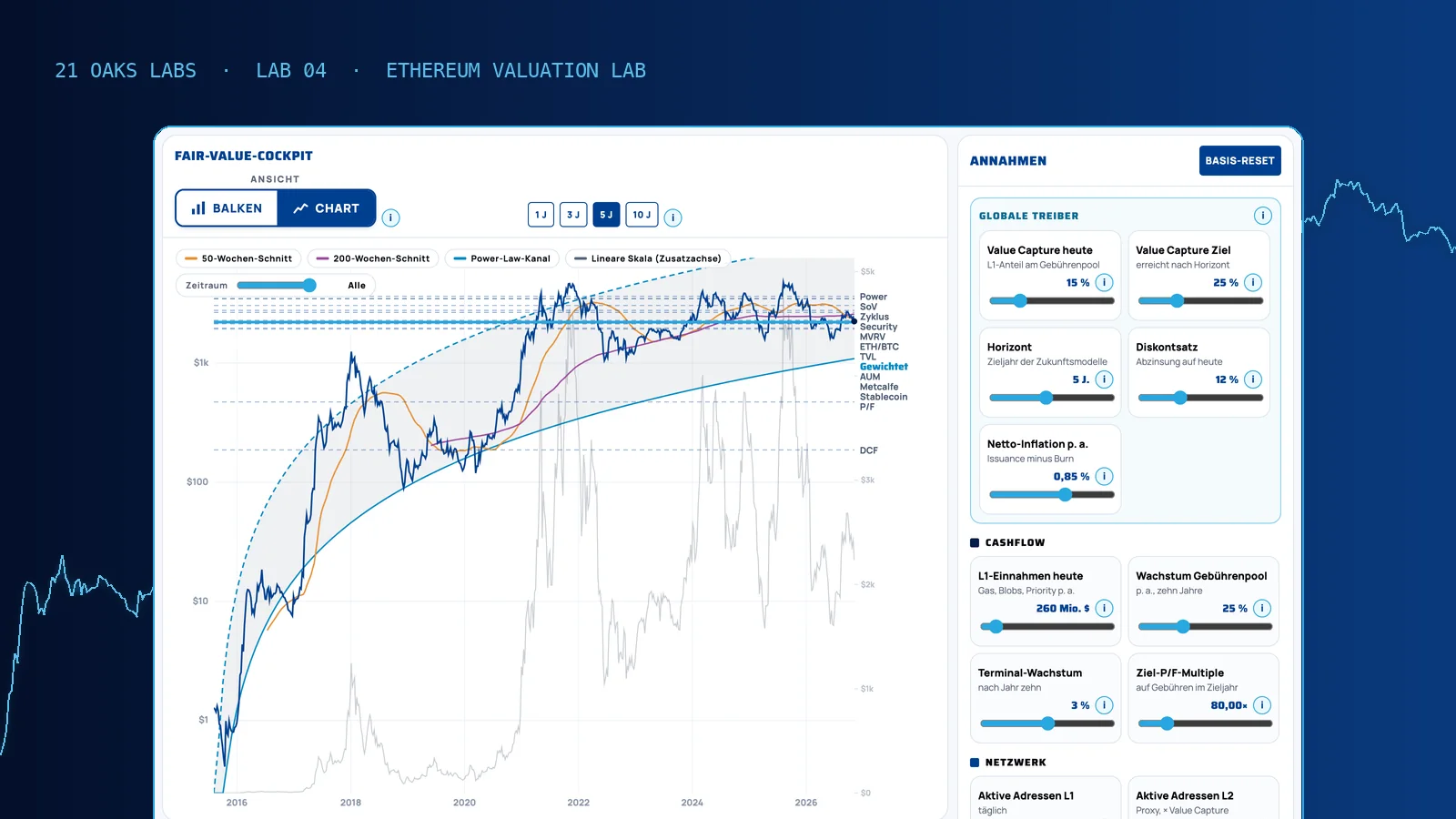
If you know the Bitcoin Valuation Lab, you will find your way at once: same controls, same terms, same views. The valuation logic is different, because three things set Ethereum fundamentally apart.
ETH is a capital asset (fees, burn, staking), a commodity (gas) and a monetary asset (collateral, reserve). Bitcoin is above all a store of value. That is why the lab works with four value pillars instead of eight equal models.
How much of the activity in the ecosystem, layer 2 included, reaches ETH as fees? This question does not exist for Bitcoin. For Ethereum it is central, so a dedicated slider affects all relevant models.
Ethereum secures stablecoins and tokenized assets. An attack must never cost less than what it puts at risk. That implies a minimum market cap, independent of fees. A 21 Oaks house model.
| LAB 01 Bitcoin | LAB 04 Ethereum | |
|---|---|---|
| Structure | 8 equal models | 12 models in 4 value pillars |
| Time | Today, Peak, Bottom in the halving cycle | Horizon of 1 to 10 years with a discount rate |
| Core thesis | Gold thesis | Security budget |
| Cash flows | None for holders | Burn and priority fees |
| Aggregation | Weighted average | Weighted or value layers |
Each model calculates its own fair value from its own assumptions. The dispersion between pillars is intended and is the actual information: it shows how much of the price rests on cash flows and how much on premiums for usage, security and monetary role.
What do the fees that actually reach ETH carry?
Discounts the fees that reach ETH over ten years plus a terminal value. The fee pool grows, ETH’s share follows the value capture path.
Limit: Very sensitive to growth and discount rate.
Values ETH like a growth company via a multiple on future fees, similar to a price-to-sales ratio.
Limit: The right multiple is an estimate and has been historically volatile.
What is network usage worth, beyond fees?
Network value grows with the square of active users. Layer 2 users count only at the value capture share, a house assumption.
Limit: Addresses are a blurry proxy for users.
Relates market cap to the stablecoin volume Ethereum settles and secures.
Limit: Stablecoins can migrate to other networks.
Market cap as a multiple of the capital locked in the ecosystem.
Limit: TVL moves with the prices of the locked assets.
What is ETH worth as security, collateral and reserve?
Minimum value that keeps an attack on the secured assets unprofitable. Links ETH to stablecoins and tokenization, independent of fees.
Limit: The attackable share is an assumption, not a law of nature.
Asks what share of the gold and Bitcoin pool ETH can reach as collateral and reserve.
Limit: Assumes ETH competes for the same demand.
Translates an allocation rate of global assets under management into a market cap.
Limit: Both inputs are estimates, and the model says nothing about timing.
Where does ETH stand against cost basis, Bitcoin and its own history?
Values the average on-chain cost basis of all ETH at a target multiple.
Limit: Only a few complete market cycles as a data basis.
Links this lab to the Bitcoin Valuation Lab: your BTC fair value times a target ratio. This gives one consistent crypto view.
Limit: The ratio is an assumption and depends on the Bitcoin value.
Log trend of the price over time since genesis, fitted on actual price history.
Limit: Much less established for ETH than for BTC, hence a low weight.
A multiple of the last cycle high. A market-based heuristic, calibrated in hindsight.
Limit: Ethereum has no halving as a clock.
Bear, Base, Bull or Tokenization set the assumptions to a coherent world view. Base is the neutral, individually justified starting point.
Every slider explains its definition, range and the reason for its default. Value capture, horizon and discount rate affect many models at once.
The weighting is your thesis, not ours. Or stack the value layers and decide how much premium you accept.
The lab adopts your BTC fair value from the Bitcoin Valuation Lab. Plus a chart view with a power law channel since 2015.
All twelve models with formula, default and limits, all sliders with source, the scenarios and metrics, plus conflicts of interest and legal notices. In German.
No. The lab is an educational tool. It shows how different models and assumptions affect a calculated value. It says nothing about how the price will develop.
Because Ethereum generates fees, pays stakers and secures assets. Stock-to-flow or mining costs do not fit that. Instead there are models Bitcoin does not have, such as the Fee DCF or the security budget.
Value capture describes how much of the economic activity in the Ethereum ecosystem reaches ETH as fees. Since layer 2s took over much of the activity, this is the central question of any Ethereum valuation.
No. If you have opened it in the same browser, the Ethereum Valuation Lab adopts your BTC fair value automatically. Otherwise it uses the current Bitcoin price. Both values can be overwritten freely.
Nothing. Access is free, the only requirement is an active subscription to one of our newsletters.
Sign in with your newsletter address, no password needed. No subscription yet? Then subscribe to one of our newsletters first.
All Labs tools are for information and educational purposes only. They do not constitute investment advice or a recommendation to buy or sell financial instruments.