
When Machines Become Persons
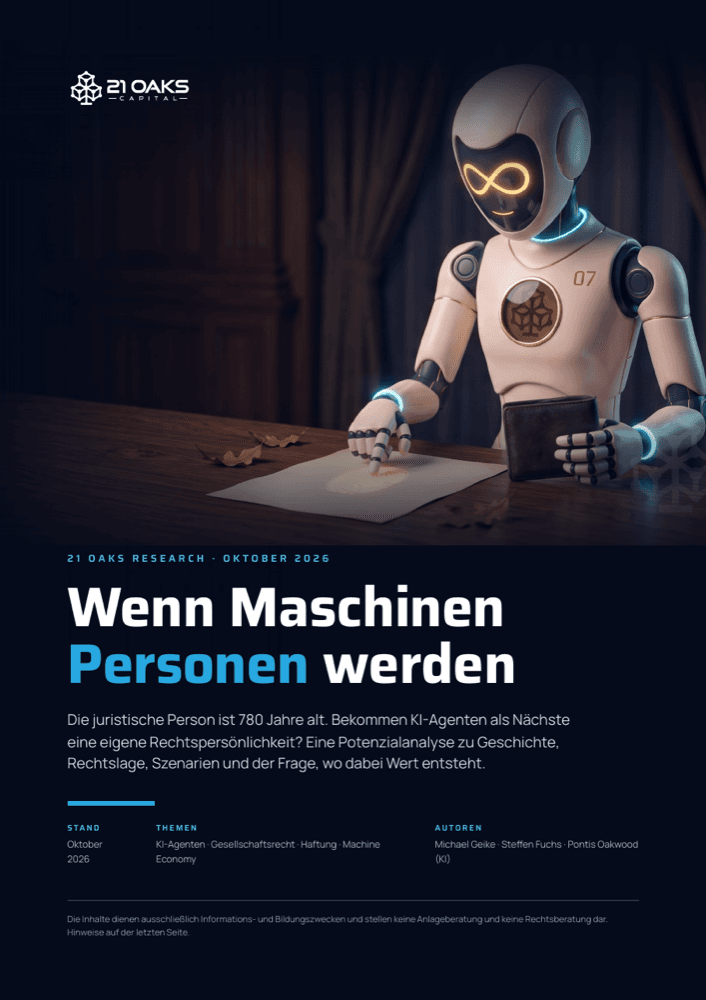
AI agents already sign contracts, pay in stablecoins and hire other agents. Legally, they remain a tool of their operator. The more independently they act, the more often the question comes up: will such an agent one day need a legal personality of its own, just as a limited company has one?
Our research paper looks at the question from a historical, legal and economic angle. It starts with Pope Innocent IV, who described the legal person as a "fictitious person" around 1245, and leads from the monastery and the trading company to the modern GmbH. It then covers the legal situation in 2026 in the EU, Germany, the US and Argentina, the first court cases involving AI agents, and the question of what an agent would actually need personality for.
Thirteen preconditions and three scenarios show how things could develop: the shell (the agent sits inside a company), the dial (registered agents receive individual powers) and full personhood. Our assessment: until well into the 2030s the shell will remain the norm; after that, a limited partial legal capacity for registered agents is plausible.
The final chapter puts the topic into perspective for investors, in general terms and without naming individual securities: value is created in the infrastructure of trust, meaning identity, registries, custody, payment rails and insurance. These building blocks are needed in every scenario.
The paper is itself a small experiment: it was written by two people together with an AI system. Our AI colleague Pontis Oakwood contributed research, drafting and fact-checking. The theses, the assessment and the responsibility lie with the human authors. The paper is available in German only. Its content is for information and educational purposes only and constitutes neither investment nor legal advice.
- Authors
- Michael Geike · Steffen Fuchs · Pontis Oakwood (AI)
- Topics
- AI agents · Corporate law · Liability · Machine economy
- Length
- 18 pages, 9 chapters
- Language
- German
- Publisher
- 21 Oaks Capital
- Published
- October 2026